METALS AND STONES
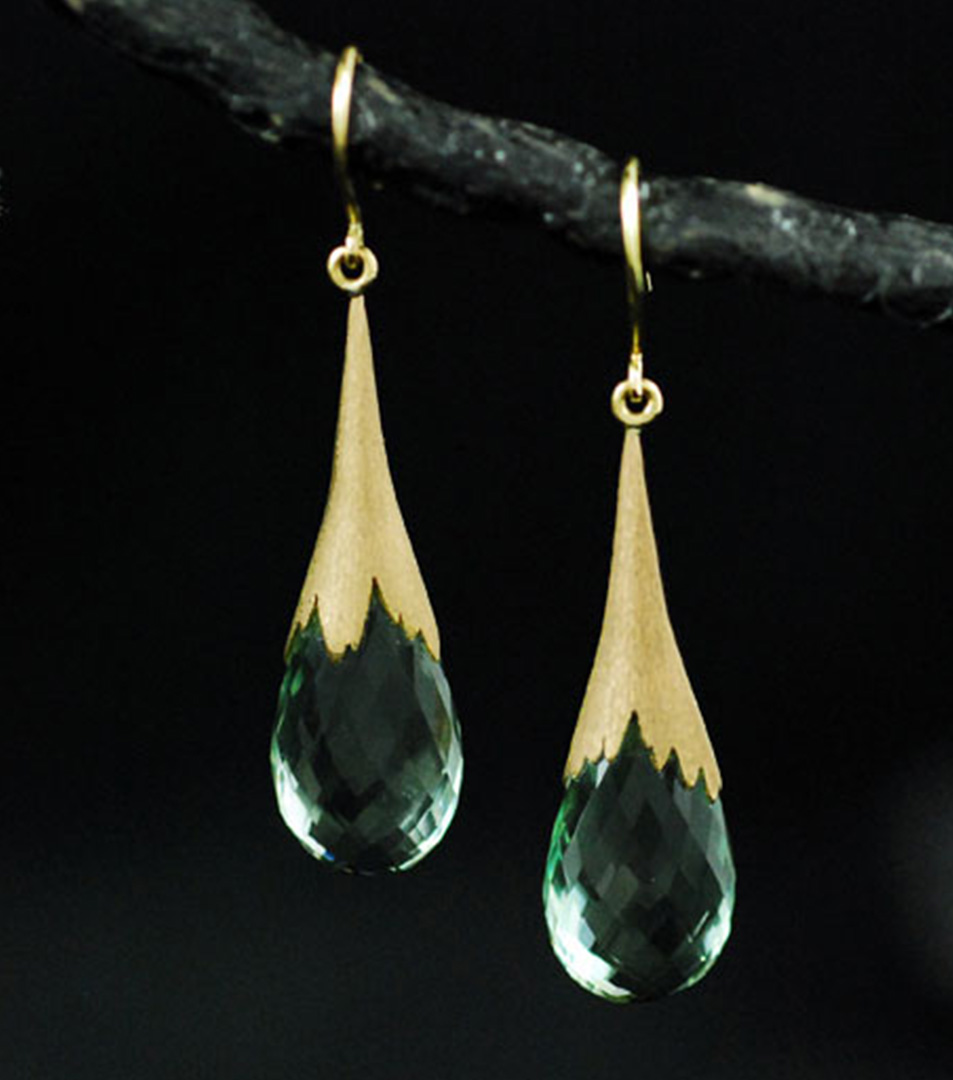
Our jewellery is made from silver, vermeil, yellow, white or pink gold and set with semi-precious or precious stones.
Some definitions...
SEMI-PRECIOUS AND PRECIOUS STONES
There are four types of precious stone: diamond, ruby, sapphire and emerald.
The other, gem-quality stones, which may include some of organic origin (coral, cultured pearl) are considered semi-precious; they are officially described as ‘fine stones’. Today the old term ‘semi-precious stones’ is still only used in English. And for us there are two reasons for using the same – visitors to the shop often confuse ‘fine stone’ with ‘fine pearl’; and the unique charm of ‘semi-precious’ evokes the ‘demi-mondaine’ mistresses from the worlds of Proust or Maupassant – less expensive but often just as stunning as their noble counterparts, they are also objects of desire...
PRECIOUS AND SEMI-PRECIOUS STONES
Brunehilde ring set with a labradorite.
PRECIOUS AND SEMI-PRECIOUS STONES
Brunehilde ring set with a pink tourmaline.
DIAMONDS
Diamonds exist in various colours, ranging from white to black with shades of yellow, brown and grey – jonquille, honey, cognac diamonds.... Their value depends on their purity, weight and the quality of the facetting, which determines their sparkle, plus the beauty of their colour.
The latter depends on the expert’s eye when it comes to coloured diamonds.
DIAMONDS
The family of white diamonds is subject to an internationally recognised assessment model. This involves precision rating scales for measuring each component defining the quality of the stone.
Excepting blue, green or red diamonds, so rare only a few exist worldwide, ‘white’ (clear) diamonds are the most expensive.
UNCUT DIAMONDS
Tiny uncut diamonds on the Forever necklace.
FINE AND CULTURED PEARLS
Natural pearls, otherwise described as fine pearls, are produced naturally without any human intervention, both at sea and in fresh water. Their high price is dictated by their rarity - originally such pearls were worn exclusively by women in high society.
Due to growing demand for pearls, they are now cultured artifically in large quantities. Today cultured pearls represent 90% of the international pearl industry.
CULTURED PEARLS
Cultured pearls are not imitations of this precious matter, but an organic process provoked by human intervention: man forces the pearl oyster to produce pearls by introducing a foreign body into its shell.
For fine pearls, the foreign body enters the oyster by accident. In both cases, to defend itself the oyster neutralises the intruder by secreting concentric layers of nacre around it. The finer and more numerous the layers, the more opalescent the resulting pearl.
TRIO OF GOLD: YELLOW, WHITE AND PINK
These terms describe the combination of metal and fine gold used to produce 18 carat gold (also called 750/1000 gold) in jewel making. Pure gold (1000/1000 or 24 carat) is too easily deformed.
For 1000 thousandths, regardless of its final shade the gold will contain 750 thousandths of fine gold, and, depending on its colour: 125 thousandths of silver and 125 thousandths of copper for yellow gold; 200 thousandths of copper and 50 thousandths of silver for pink gold; 170 thousandths of palladium and 80 thousandths of copper for white gold (also called grey gold).
Note: since the use of nickel is now forbidden in jewel making, white gold combined with palladium alone produces the final white (or grey) shade after rhodium plating. This process of electrolysis may, depending on the type of skin (e.g. acidity) in contact, last for years or require further treatments over the years.
VERMEIL
This term is used to describe 925 sterling silver covered with a layer of gold at least 5 microns thick (compared to 'gold-plated', which has no minimum thickness and can cover any non-precious metal).
If the surface of a piece of vermeil jewellery has worn off over time, we can recoat it.
Hallmarks
The hallmark (or maker’s hallmark, or responsible person’s hallmark): engraved inside a lozenge, its design is unique to each craftsman. Established in 1797, this lozenge certifies French manufacture. Imported items have a hallmark inside an oval lozenge. Take a magnifying glass to check our hallmark on your piece of jewellery... here it is:
The certifying hallmark: imposed and billed by the State Guarantee Service, certifies the ‘percentage of metal’ meets French norms: the eagle head for 750/1000 gold (i.e. 18 carat gold), Minerva head for 925/1000 silver, dog head for 950/1000 platinum.
Exempt from this hallmark: gold or platinum items weighing less than 3 grammes, and silver items less than 30 grammes; however they must still carry the maker’s hallmark, by which the craftsman attests his or her work conforms to its official description.

